My OSCP+ experience
· 11 min read
OSCP+ is for many the first milestone in their cyber security journey, with PEN-200 being the course granting one the knowledge to pass it. Getting in contact with different kinds of attack vectors, problems and solutions of different variety.
For me it was rather a milestone after having already worked for one year as a penetration tester with prior intensive lessons provided by either TryHackMe, HackTheBox or pwn.college.
NOTE
Special shoutout to async security and their W200 AD exploitation course. Having done their course well in advance made the Active Directory part in the OSCP+ a breeze. More about this in a different post.

Dark hooded figure scheming.
Instead of focusing on my growth journey, this post is all about the mindset I required in order to pass the exam.
What is OSCP+
Since November of 2024 people did not just take on the OSCP exam based on the PEN-200 course, but rather the OSCP+ version. The exam itself changed as well as the duration of the badge being valid. source

Goodbye OSCP, hello OSCP+.
For a long time the OSCP was a lifetime credential. You passed once and it never expired. That changed on the first of November 2024: Offsec replaced the exam with an updated version, and passing it now grants you two certifications instead of one. The OSCP, which still does not expire. And the OSCP+, which is valid for three years from issuance.
The difference between the two is exactly one thing, and it is not the exam. It is maintenance. The OSCP+ exists to show you have kept the certification current, not that you earned it recently, renew it, and a five-year-old OSCP+ is still an OSCP+. Let it lapse, and you keep the OSCP for life. You lose the +, nothing else. That is a far softer cliff than most people assume when they first read “expires after three years.”
The exam beneath both changed as well. The Active Directory section was reworked to start from an assumed compromise: you begin as a standard domain user and the goal is full domain compromise. Bonus points were removed, the OSCP was the only Offsec certification that had them.
Even though the content is different, it is as always mainly about acquiring knowledge and proving you understood it and are able to prove it. (Which is the premise of every course ever made).
What is so different about the OSCP+?
To me it was about breaking away from common patterns and being open to unusual vectors. With lots of the course material being already familiar, it was mainly about re-experiencing the content and discovering new vectors rare to encounter but possible nevertheless.
Everything is possible as long as you “Try Harder!”, and the OSCP is about building a mindset for problems the course never mentions. This is especially true with many of the labs requiring the user to seek answers not contained in the material, but outside in the dark wild corners of the Internet.
Wizard doing dark computer magic in the dark wild corners of the internet.
Challenges
I separate this part into several sections. The challenge itself is composed of several factors which are weighted depending on your prior experiences and expectations.
- Mindset so far
- Offsec Mindset
- Preparing for the worst
Mindset so far
During my time prior to taking the PEN-200 course I experienced different biases depending on the platform one is taking the courses on. For example TryHackMe is often about finding misconfigurations, HackTheBox is all about finding vulnerable components and exploiting them, and pwn.college requiring lots of in-depth understanding to formulate an easy solution to a complex task.
Every time it came down to the meta a website asked one to fulfil, letting students adapt to the course contents and their expected type of problem solving.
Naturally this gives one a sense of accomplishment and allows one to build rapport for just that one website. But afterwards transitioning to a different provider often felt unsatisfying. With all those skills already built and a mindset taught to look for specific indicators, they all made one think just the one way required to tackle a challenge.
In contrast, doing a CTF the creator is rarely the same person and therefore it requires one to always adapt to the challenge at hand.
This is the main reason especially at the beginning when starting to tackle different challenges for the PEN-200 course, some came naturally allowing one to blaze through the material. With others expecting the user to execute an oddly specific attack one has rarely encountered before. As you probably already are aware, dear reader, this means there is no one mindset to succeed in the course and therefore the exam.

Martial Artist practicing Desktop Kun Fu.
Empty your mind. Be formless, shapeless, like water. - Bruce Lee
I can not really confirm it, but in theory this would mean someone with no mindset so far and not having experienced other methodologies might fare better than someone thinking they already have built a mindset and are able to tackle any problem the OSCP+ might throw their way.
Offsec Method
Offsec expects its students to have most of the course content ingested, with some parts simply not being applicable to an exam. Looking around the internet one quickly finds out about parts worth skipping and other parts getting special attention.
That shortcut-hunting is a trap. Chasing what the internet says is worth skipping, I quietly discarded clues the course had already given me. My own pentest methodology didn’t save me either, it told me what to look for, which is exactly what the unusual box wasn’t. More than once it was sheer creativity that got through.
Use anything given to you, work methodically and most importantly enumerate the heck out of everything to find any possible edge towards success.
Preparing for the worst
This point is kinda ironic. For me “preparing for the worst” meant having a cheat sheet at hand containing any possible technique possibly asked for in the exam. To avoid going on tangents and following rabbit holes without a promising goal, I was set to use techniques taught by the course or being somewhat adjacent.
But facing the worst actually meant letting go of all the pre-done effort or preparation in the face of a challenge one had not experienced yet. It was about the willingness to accept not knowing what to do and starting to learn a topic from the ground up. In the context of the OSCP+ it does not mean learning a completely new class of vulnerability, but rather learning a technology or concept unfamiliar to one. These can often be easily read up on online by looking for keywords or by going to specific websites dedicated to it like HackTricks.
But as already said, this worst part is all about venturing into something you have no idea about, to do it essentially for the first time under pressure and with eyes watching you.
How to actually prepare
Whilst the course contains three mock-up exams, which had been truly similar to the exam itself, the number of machines itself was finite. A different source of machines following the same design principles are contained in the Offsec Proving Grounds. They are the recommended resource for one to prepare the exam besides the already mentioned mock-up exam.
But if you were like me and already had a running HackTheBox subscription or are on a free tier, the extra Offsec subscription might not sound that attractive. To still supplement this I can recommend the popular list of practice machines curated by 0xdf. The OffSec Exam HTB Lists contains many machines similar to Offsec’s meta and can give you insights on what techniques one possibly needs to acquire.
Doing this will certainly have its benefits, but nothing beats a well carved out plan on how to enumerate which target. Or creating playbooks for different kinds of vectors.
Personally the pivoting part during the PEN-200 course was not to my liking, due to the usage of so many different tools with almost the same purpose. So in order to properly prepare I decided on the tool Chisel, prepared the binaries for all different environments and had the commands ready to paste. This meant not wasting precious time during the exam and having a workflow at hand where you know every possible fail point and how to fix it.
While lots of the time is being spent in the terminal executing different tools and collecting input, the most crucial time spent is working through the cheat sheets and course notes or even googling away in search of a solution. Having optimized that part is probably one of the most important steps in preparation for the exam. A similar view to this is also being expressed by NTH Security in his video, where he describes how he managed to pass the exam within four hours. He isn’t talking about how to find the perfect exploits or how to tackle any machine, but rather about setting guiding lights throughout your notes, allowing yourself to worry about other things during the exam.
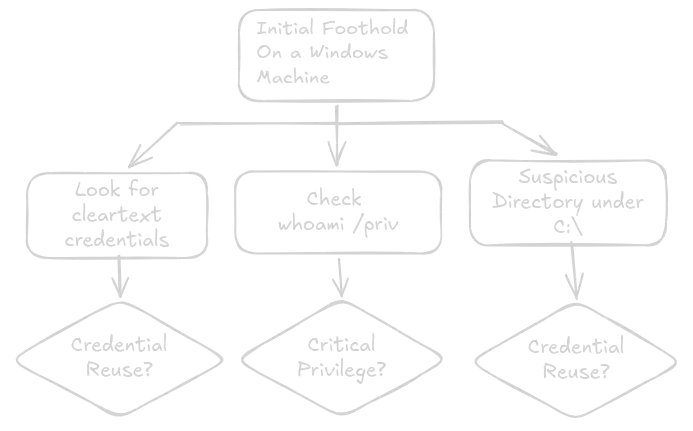
Sample Workflow for an initial foothold on a Windows system.
In this small example above one would imagine a starting position which might be typical. It is important to structure it in a way allowing one to piece the final path together. In this case we prepare for getting the initial foothold and we have no idea what to do next.
In order to not go blind into this and not simply rely on the automated output of some tools like PEASS-ng, we would first go for some low hanging fruits. In the case of the OSCP+ exam this would be cleartext credentials one has to find with PowerShell commands taught in the course. They might be in the home directories, history or on a SMB share. A simple whoami /priv might reveal dangerous permissions allowing one to utilize mimikatz or even do a backup of some hashes stored on the machine. Special mentions for simply checking under C:\ to find an unusual directory there. In some cases there are tools containing credentials or hinting at vulnerable versions of the tool itself.
This way one can test their own creativity and think about possible scenarios. Thanks to the developments of AI one can easily have a sparring partner at hand to discuss possible scenarios, even to challenge ideas or do it as a tabletop exercise.
Two last things to share
The Active Directory part was the easiest part of the exam. Having done the mock-up exams and due to Windows exploitation being such a broad and easy-to-lose-track-in field, it felt to me more manageable than the stand-alone machines. So especially here the playbook tip would do wonders.
Secondly, do not rush the exam. Even if you take the three month course access period, you can schedule the exam for way later. This allows you to first focus on the course and the course-included machines. After that either do the Proving Grounds or other similar machines to actually practice facing difficult machines. This is especially important when taking the data into account published by Offsec themselves in 2020. Meaning it is outdated and not applicable to the current course, but reflects some insights nevertheless.
Source: https://www.offsec.com/blog/pwk-labs-success/, visited on 3rd of November 2026.
The chart plots pass rate against the number of machines a student had compromised in the PWK labs. The curve climbs until somewhere around 40 to 50 machines, then flattens. It never reaches the top of the chart. Offsec says as much themselves, the number of exploited machines alone is not a good estimation of success, and following a walkthrough is not a substitute for actual learning.
So the takeaway is not that a specific count guarantees a specific outcome. It is that the ceiling exists. You can do everything the chart asks and still be in the group that does not pass.
So don’t be hard on yourself if you are not able to succeed the first or second time, even when giving your best. Sometimes even in a skill-based thing like hacking, chance is still a factor possibly deciding the outcome. All you can do is prepare for the worst, optimize and be faithful in the best to happen.
Conclusion
Passing the exam is mostly about preparing for any possible scenario and knowing what to do based on indicators discovered during enumeration. Practice a variety of machines and apply PEN-200 acquired techniques, but be also prepared to face problems you never had to solve until you met the exam. Even people having compromised a shit ton of machines for preparation might fail. Sometimes chance is involved and will require you to try your best in the next attempt.

Ollie.
Footnotes
The decision tree was done in https://excalidraw.com/. Images are AI generated.